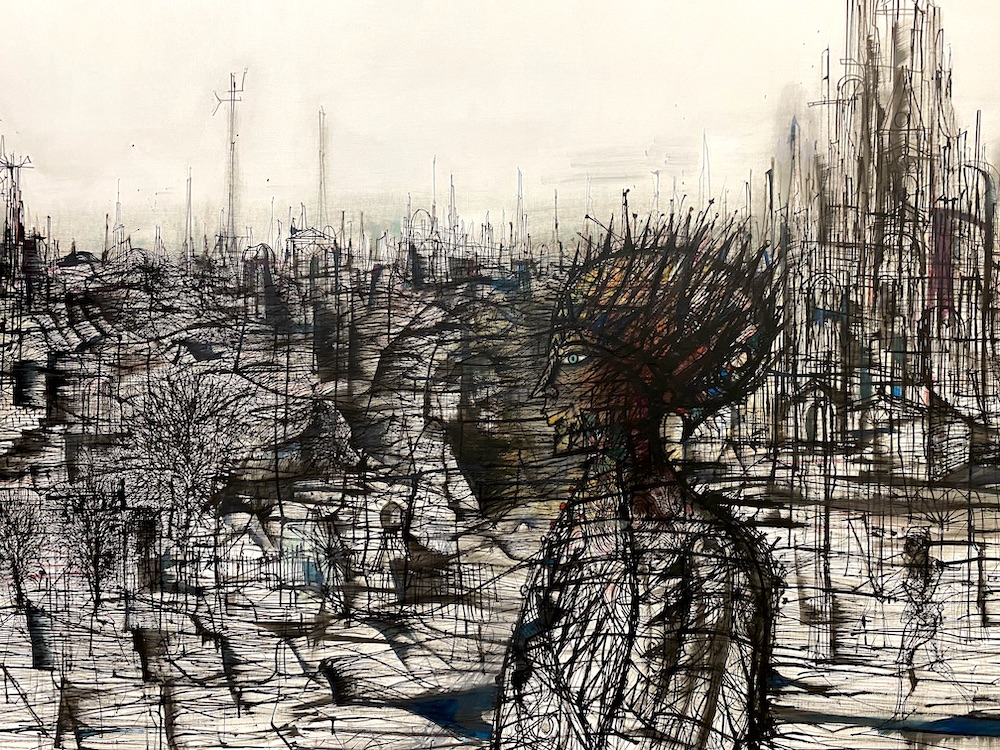
Jean Carzou (1907 Aleppo – 2000 Marsac-sur-l’Isle)
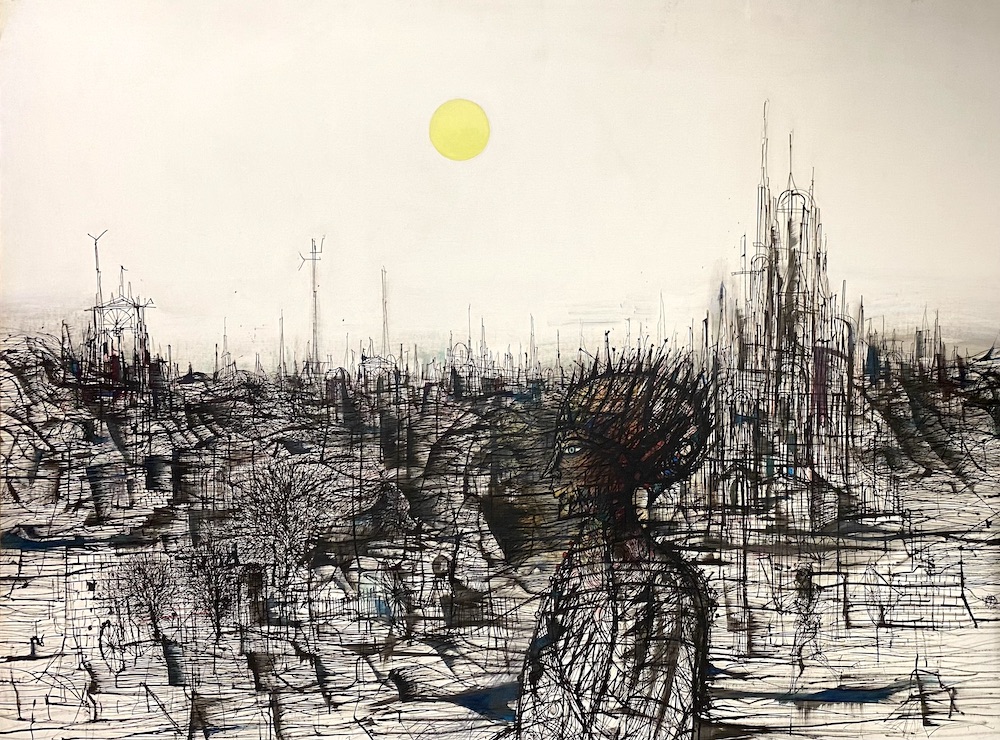
Les Conquérants
Material: Oilmix on canvas
Dimension: 200 x 250 cm
Frame: Yes
Dated: 1980
About the Artist:
Jean Carzou was a French-Armenian painter, illustrator, printmaker, and stage designer whose distinctive artistic vision made him one of the most recognizable figures of twentieth-century French art. Born Karnik Zouloumian on January 1, 1907, in Aleppo, then part of the Ottoman Empire, he came from an Armenian family and spent part of his youth in Cairo before moving to Paris in 1924. There he studied architecture but soon abandoned that profession in favor of painting and drawing.
Carzou developed a highly personal style characterized by intricate linear structures, dreamlike landscapes, fragile architectural forms, and haunting visions of civilization under threat. His works often depicted deserted cities, railway lines, harbors, ruins, and imaginary spaces, reflecting anxieties about war, technological change, and the fragility of modern society. Critics frequently described him as a poetic and visionary observer of the twentieth century.
His career gained momentum in the 1930s, and by the late 1930s and 1940s he was exhibiting widely in France and abroad. Beyond painting, Carzou became renowned as an illustrator, producing artwork for books by major writers including Ernest Hemingway, Albert Camus, T. S. Eliot, and **Eugène Ionesco. He also designed sets and costumes for productions at the Paris Opera and other major theatrical institutions.
Throughout his life, Carzou remained deeply connected to his Armenian heritage. Although he became a celebrated figure in French cultural life, he often spoke of retaining a strong Armenian identity and drew emotional inspiration from the experiences and history of the Armenian people.
In 1977 he was elected to the prestigious Académie des Beaux-Arts, one of France’s highest artistic honors. His achievements also earned him distinctions such as the National Order of Merit and honors within the French arts establishment.
One of Carzou’s most ambitious late projects was the decoration of the Chapelle de la Présentation, where he created a monumental interpretation of the Apocalypse. Completed when he was already in his eighties, the work expressed his lifelong concern with war, destruction, and humanity’s search for hope.
Jean Carzou died on August 12, 2000, in France at the age of ninety-three. Today he is remembered as a master of poetic imagination whose paintings, illustrations, and theatrical designs bridged Armenian cultural heritage and modern French art. His works can be found in major museum collections across Europe and the United States.
The Apocalypse Chapel
The museum most closely associated with Jean Carzou today is the Fondation Carzou (now often referred to as the Centre Carzou) in Manosque, in southern France. It is much more than a conventional museum: it was created around a monumental work that Carzou himself designed during the final phase
The centerpiece of the site is a former nineteenth-century convent chapel that Carzou transformed between the mid-1980s and 1991. Covering roughly 666 square meters, the decoration consists of around fifty paintings and stained-glass windows inspired by the theme of the Apocalypse. Rather than illustrating the biblical text literally, Carzou used it as a meditation on the tragedies and hopes of the twentieth century.