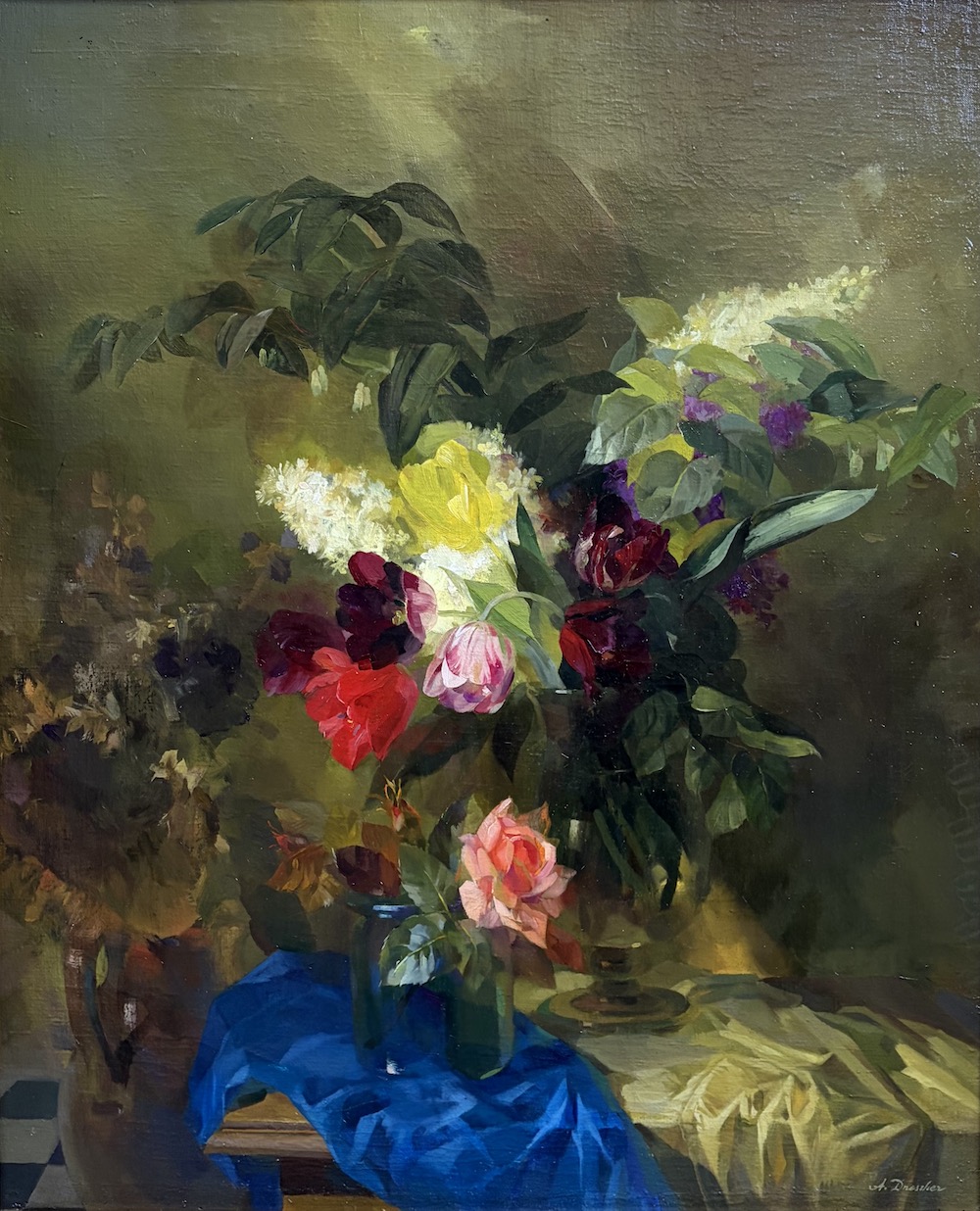
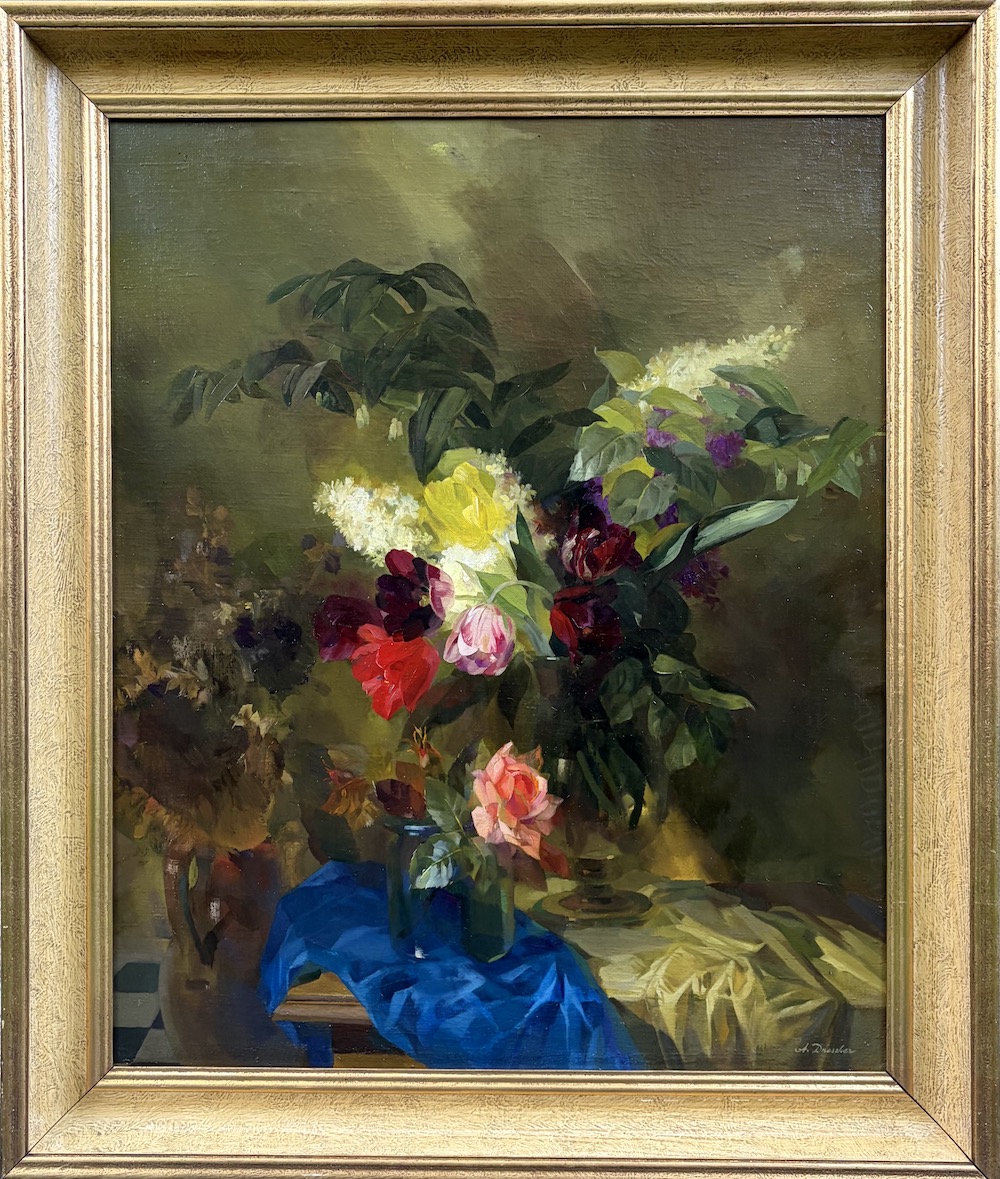
Arno Drescher (Auerbach 1882 – 1971 Braunschweig)
Flower Still Life
Material: Oil on canvas
Dimension: 83 x 67,5 cm
Frame: Yes
Biography
Arno Drescher (17 March 1882 – 1 June 1971) was a German painter, graphic artist, typographer, and professor whose work bridged the worlds of fine art and applied design. Born in Auerbach in the Vogtland region of Saxony, he grew up in the workshop of his father, Carl Gustav Drescher, a decorative and sign painter. This early exposure to craftsmanship and drawing laid the foundation for a career that would encompass painting, illustration, typography, poster design, and art education.
After training as a schoolteacher, Drescher abandoned a conventional teaching career in 1905 to study at the Academy of Arts and Crafts in Dresden. He quickly distinguished himself as both an artist and educator, qualifying as a specialist drawing teacher and later becoming a master student of the painter Richard Guhr. In 1916 he established his own studio in Dresden-Blasewitz, and in 1920 he was appointed professor of free and applied graphic arts at the State Academy of Arts and Crafts in Dresden.
During the 1920s Drescher exhibited alongside many of the leading figures of modern German art, including Erich Heckel, Karl Hofer, Oskar Kokoschka, Max Liebermann, Emil Nolde, Max Pechstein, and Christian Rohlfs. His paintings reveal a distinctive synthesis of academic training and modern expressionist tendencies. Particularly admired are his flower pieces, still lifes, landscapes, and studies of nature, characterized by expressive colour, strong light effects, and a sensitive observation of form.
Alongside his work as a painter, Drescher became one of Germany’s most influential graphic designers. He created posters, banknotes, stamps, commercial trademarks, and book illustrations. He designed typefaces such as Arabella, Energos, Helios, Duplex, and Manutius, and contributed significantly to German typography during the interwar and post-war periods. Among his best-known commercial designs were logos and symbols for major German companies, including the historic emblem of Audi and the trademark of Hachez chocolate.
In 1940 Drescher became deputy director and later director of the Academy for Graphic Arts and Book Production in Leipzig. During the Second World War, tragedy struck when his Leipzig studio was destroyed in the bombing of 1943, resulting in the loss of much of the artistic work he had created over the previous three decades.
After 1945 he worked as a freelance painter, graphic artist, and typographer in Leipzig. He continued to exhibit widely in both East and West Germany and devoted considerable effort to botanical illustration, including extensive watercolour studies of medicinal plants for a planned atlas. In 1960 he moved to Braunschweig, where he remained artistically active, maintaining a studio and continuing to paint until the final years of his life.
Arno Drescher died in Braunschweig on 1 June 1971 at the age of eighty-nine. Although his reputation today rests largely on his achievements as a typographer and graphic designer, recent scholarship has renewed interest in his paintings. Art historians increasingly regard him as a representative of the “Forgotten Generation” of German artists whose careers were shaped by the political upheavals and wars of the twentieth century. His surviving paintings reveal a gifted colourist and observer of nature whose work deserves a place within the broader history of modern