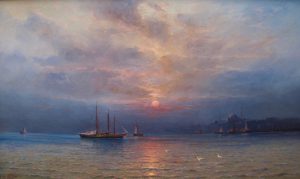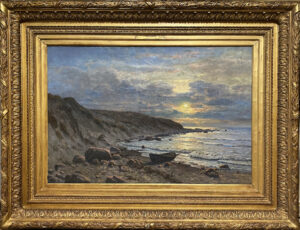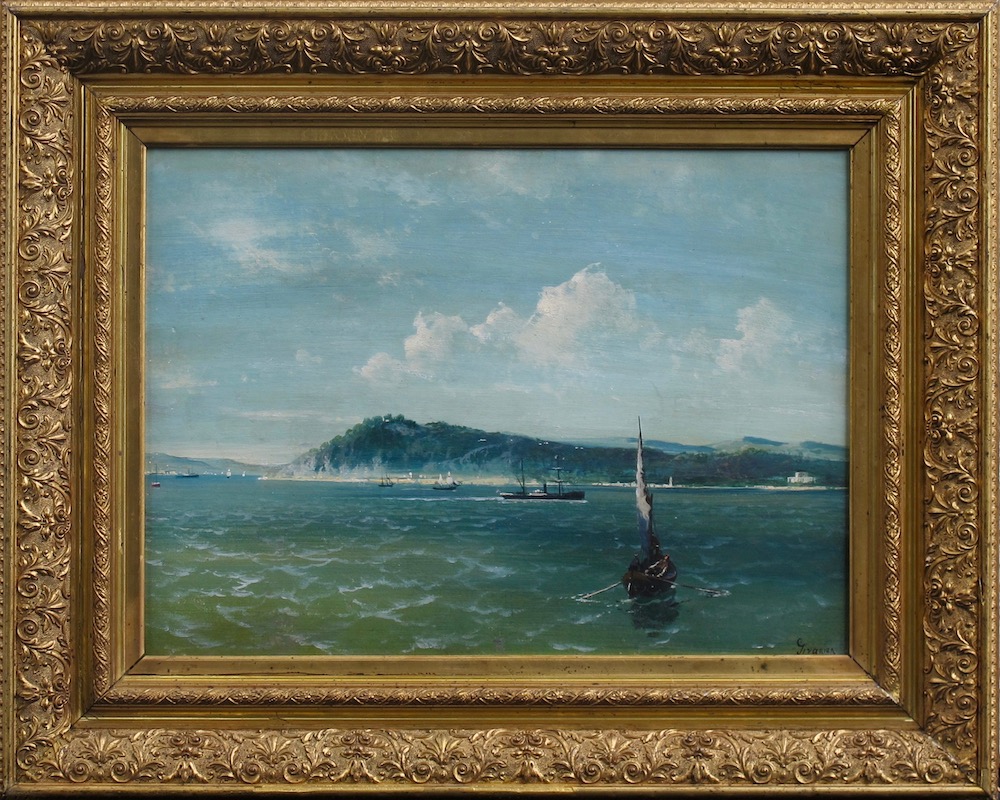
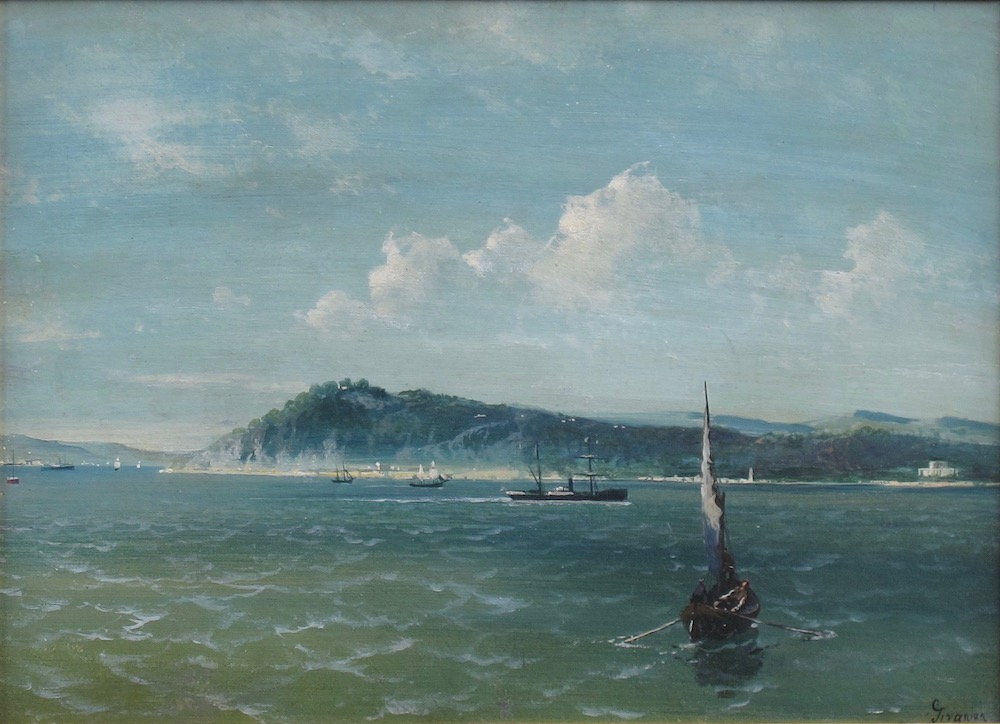
Mekertich Givanian (Istanbul, 1848 – 1906)
At the Bosphorus
Material: Oil on carton
Dimension: 45 x 63 cm
Frame: Yes
About the Artist:
Mekertich Givanian (also known as Mıgırdiç Civanyan) was one of the most important Armenian painters of late Ottoman Constantinople. Born in Beşiktaş, Istanbul, in 1848, he became celebrated for his atmospheric depictions of the Bosphorus, moonlit harbors, stormy seas, and the changing light of Istanbul’s waterfront. His work occupies a unique position between Ottoman court art, European Romanticism, and Armenian cultural history.
Givanian was born into an artistic and musical family. His father, Hovhannes Givan, served as a court violinist during the reign of Sultan Abdülmecid, exposing the young artist to the cosmopolitan cultural environment of nineteenth-century Constantinople. He first studied drawing at an Armenian school in Beşiktaş and later trained under the painter Abraham Sakayan. In 1874 he entered the drawing and painting studio directed in Pera by the French artist Pierre Désiré Guillemet, one of the leading European academic painters active in the Ottoman Empire.
A decisive moment in Givanian’s artistic development came when he encountered the renowned Armenian-Russian marine painter Ivan Aivazovsky in 1874. Aivazovsky’s luminous seascapes profoundly influenced him, inspiring his lifelong fascination with marine painting and dramatic atmospheric effects. From that point onward, Givanian devoted much of his work to the sea: sunsets over the Bosphorus, ferries crossing the Golden Horn, lighthouses, storms, and moonlit coastal scenes became recurring subjects.
Between 1876 and 1879 he traveled and studied in Italy, where he absorbed elements of European landscape painting and refined his command of color and perspective. Italy also shaped his personal life: after returning to Istanbul he married an Italian woman in 1885 and became closely connected with the city’s Levantine and Italian communities.
Back in Constantinople, Givanian worked not only as an easel painter but also as a decorator and stage designer. He collaborated on decorative projects connected to important Ottoman palaces and theaters, including works associated with the Çırağan and Beylerbeyi palaces. His ability to combine theatrical composition with delicate handling of light contributed to the poetic atmosphere of his paintings.
Givanian’s mature works are especially valued for their historical depiction of old Istanbul. He painted Sarayburnu, the Maiden’s Tower, Tophane cafés, Fenerbahçe, the Princes’ Islands, and quiet stretches of the Bosphorus before modern urbanization transformed the shoreline. His paintings often show Istanbul suspended between East and West, tradition and modernity: sailboats coexist with steam ferries, Ottoman architecture glows under European-style romantic lighting, and the sea becomes both a geographical and emotional center of the city.
The political violence directed against Armenians during the Hamidian massacres deeply affected his life. In 1894 he left the Ottoman Empire and sought refuge in Odessa, then part of the Russian Empire. After several years there he moved to Saint Petersburg, where he continued painting and remained connected to Armenian artistic circles. Around 1905 he returned to Istanbul, but his health had deteriorated, and he died on 14 February 1906.
Today, Mekertich Givanian is regarded as one of the foremost Ottoman Armenian marine painters. His works survive in museums and private collections in Turkey, Armenia, and Europe, including collections associated with the Istanbul Modern. Art historians value him not only for his technical skill and luminous treatment of water and atmosphere, but also because his paintings preserve the visual memory of nineteenth-century Istanbul.